I spend a lot of my week in rooms with mid-market CEOs, and I have started to notice the same thing in almost every one of them. The CEO has approved an AI budget. They have hired a consultant, or stood up a committee, or told the all-hands that this is the year the company gets serious about AI. They can talk about it at the board level fluently. And then, when I ask them to open the tool on their own laptop and show me how they actually use it in their week, there is a pause. Most of them can't. They are leading a transformation they have personally never been inside.
I do not say this to embarrass anyone, because it is completely understandable and it is nearly universal. These are people who got to the top of a company by being excellent at things that are not this. But it is worth naming plainly, because it is the quiet bottleneck on most of the AI programs I see at companies between $20M and $500M: the person with the most authority over the AI agenda is frequently the person with the least direct experience of the thing.
Authority is not fluency, and the gap between them is where money gets wasted
There are two different things a leader can have, and we tend to confuse them. One is authority over AI: the budget, the mandate, the org-chart ownership. The other is fluency in AI: the lived, hands-on sense of what these tools are actually good at, where they break, what a real workflow feels like versus a staged demo. Most mid-market CEOs I meet have a great deal of the first and almost none of the second.
That gap matters more than it sounds, because nearly every important AI decision a CEO makes is a judgment call that depends on fluency they don't have. A vendor walks in with a polished demo. Is that a real capability or is it theater? The head of data wants nine months and a platform. Is that the right scope or is it empire-building? A competitor announces an AI feature. Is that a genuine threat or a press release? You cannot answer any of those from a briefing. You can only answer them from having done enough of the work yourself to have a gut that is calibrated to reality.
A CEO who has never used the tools is forced to outsource judgment on the most consequential bets to whoever sounds most confident in the room. That is not a strategy. That is a coin flip with a budget attached.
I watched the exact same thing happen in the last three waves. The executives who navigated cloud well were not the ones who could recite the AWS service list. They were the ones who had personally felt the difference between a server you wait six weeks for and one you spin up in a minute. The ones who got data right had actually sat with a dashboard and felt how a decision changes when the number is in front of you. Fluency at the top is not a nice-to-have. It is the thing that lets a leader tell the real bet from the expensive distraction.
Why the usual fixes don't create fluency
Here is the part that frustrates me, because companies are spending real money trying to close this gap and mostly buying the wrong thing.
The keynote does not do it. Bringing in a famous AI speaker for an inspiring ninety minutes produces a room full of energized people who still cannot do anything Monday morning. The online course does not do it either; the completion rates on those are a punchline for a reason, and watching someone else use a tool is to fluency what watching someone else swim is to swimming. "Just go play with ChatGPT" does not do it. Without a specific problem from your own week, you poke at it for ten minutes, get a mediocre answer to a generic question, and quietly conclude it is overhyped. And the company-wide rollout, where everyone gets licenses at once, definitely does not do it, because you have now scaled an activity that the most important user in the building still cannot model for anyone else.
Fluency is not information. You cannot be briefed into it. It is a motor skill, and like any motor skill it comes from reps on real work, your real work: the actual decisions and documents and analyses that fill your specific week, with someone who already knows the moves standing next to you while you do it.
What fluency actually looks like for a CEO
I want to be concrete, because "fluency" can sound abstract and aspirational. It is not. It is small and specific.
It is the CEO who now drafts the first version of the board narrative herself in twenty minutes, then spends her time sharpening the argument instead of staring at a blank page. It is the COO who pressure-tests a deal model by having the AI argue the bear case against his own assumptions before the investment committee does. It is the founder who pulls three years of customer churn notes into a coherent pattern on a Sunday night instead of waiting two weeks for an analyst to have capacity. None of these are moonshots. Each one is a real task that used to cost hours or days, now done in minutes, by the executive personally.
The compounding effect is the part people underestimate. Once a leader has felt that a few times in their own work, every downstream decision gets better. They stop being impressed by demos, because they know what is easy and what is hard. They scope projects correctly, because they have a feel for the real shape of the work. They can tell their own team what good looks like, because they have done it. Fluency at the top speeds up the CEO and raises the quality of every AI judgment the company makes underneath them.
The fastest path is your own workflow, not your org chart
So if fluency comes from reps on real work, the implication is uncomfortable for the way most companies sequence this. The instinct is to start big and broad: train the organization, roll out the licenses, announce the initiative. But the fastest route to a fluent company often starts with a single fluent leader, because that leader is the one who sets the standard for everything below.
Start with you. Take the actual work that fills your week (board prep, strategy memos, financial models, customer analysis, hiring decisions) and one piece at a time, build a way to do each of them with AI in the loop. Not a generic tool you might use someday. A specific thing wired to your specific work, that you use this week and the next, until using it is automatic and not using it feels slow.
That is a very different exercise from a training program, and it needs a different kind of help. It is closer to working with a coach who is also a builder: someone who has the operating background to know which of your problems are worth pointing AI at, and the hands to actually build the thing rather than recommend that someone build it. That combination is exactly what I found was missing in the market, and it is why I shaped one of our engagements the way I did.
Yes, this is what our AI Concierge is. Here is why it's built this way.
I will say the obvious thing out loud, because you are already thinking it: I run a service that does precisely this, so of course I am telling you it is the answer. Hold it to a higher bar for that reason. Here is the honest version.
Our AI Concierge is personal AI implementation for one senior executive (a CEO, CFO, COO, or division president) who wants to be genuinely fluent and have working tools in their own week, without waiting on IT, budget cycles, or a company-wide program. It is deliberately small and deliberately hands-on. Four working sessions a month, forty-five minutes each, on a standing weekly cadence. Unlimited async access in between, because the questions that build fluency show up mid-task, not on a calendar. And at least one working build every month: a real tool wired to your real work, not a tutorial.
The shape is the argument. Weekly, because fluency is a motor skill and motor skills need frequency. Built around your work, because reps on someone else's example do not transfer. One real build a month, because the fastest way to learn what AI can do for you is to watch it do something for you that you actually needed done.
The goal is not to make you dependent on me. The goal is to make you not need me. By the end you should have working tools and your own calibrated judgment, the thing no keynote, course, or consultant can hand you.
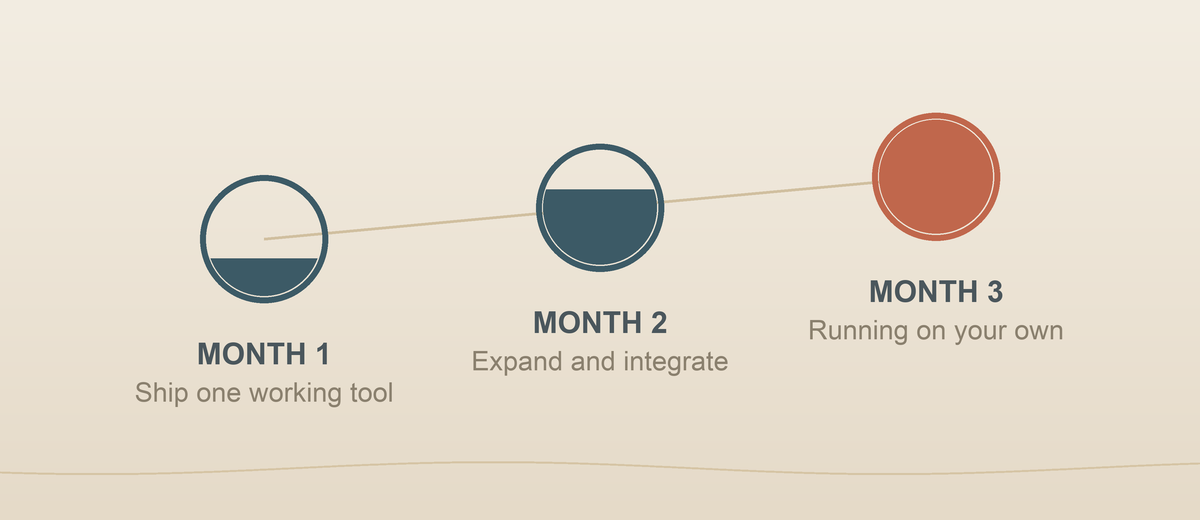
That is the part I care most about. The 90-day arc is built to end with you running three to five tools on your actual work, and with enough fluency to keep going on your own. If a CEO finishes still needing me to operate their tools, I did the job wrong. The deliverable is your judgment, not my retainer.
What to do in the next 90 days
You do not need a strategy offsite to start closing this gap. You need to pick one piece of your own work and do it with AI in the loop this week, then do it again next week, until it is a habit and not an experiment. If you want to do that alone, genuinely do. The leaders who get fluent any way at all are better off than the ones still approving budgets for a thing they have never touched.
If you would rather have someone who has led through cloud and data and AI sitting next to you while you build, that is the conversation to have. As always, it starts with a twenty-minute call. No deck, no pitch. We talk about your actual week, the two or three places AI would change a number you care about, and whether getting personally fluent is the right next move or whether one of the other engagements I run fits better. If it is not a fit, I will tell you.
More on this: the AI Concierge page lays out the weekly cadence and the 90-day build plan in full. If the gap is bigger than you and reaches across the leadership team, AI Executive Coaching & Team Training is the version that scales the same idea to your people. And Why your first AI hire shouldn't be a Chief AI Officer covers the related trap of trying to solve a fluency problem with an org-chart move. When you are ready, a twenty-minute call is the start.