Ask most people what AI in sales looks like and they describe a chatbot or a cold email machine. Those exist. They are also the least interesting part of the story.
The interesting part is the middle of the deal. The customer wants to buy. The rep knows what they are selling. And the deal sits for days because somebody has to build a document. Here is a real example.
The CloudSAFE problem
CloudSAFE is a managed hosting and disaster recovery provider. Their deals are technical: IBM Power capacity, x86 workloads, SAN replication, multi-year terms. Every deal produces a CPQ quote, a dense export of SKUs and pricing.
You can't send a customer a CPQ export. It says what they are buying. It says nothing about why. So after every quote, a rep built a proposal by hand. Pull the line items into a presentable format. Write up the background from the discovery calls. Get the branding right. Produce something the customer can walk into their own boardroom with.
That took hours per deal, sometimes days on a busy week. Quality depended on which rep built it and how rushed they were. And every hour spent formatting slides was an hour not spent selling.
What the AI version looks like
The rep shares what already exists: the CPQ export, the recordings or transcripts from the discovery calls, and any notes on the deal.
From that, the system builds a branded seven-page proposal in two formats, a print PDF and an editable PowerPoint deck. It takes minutes.
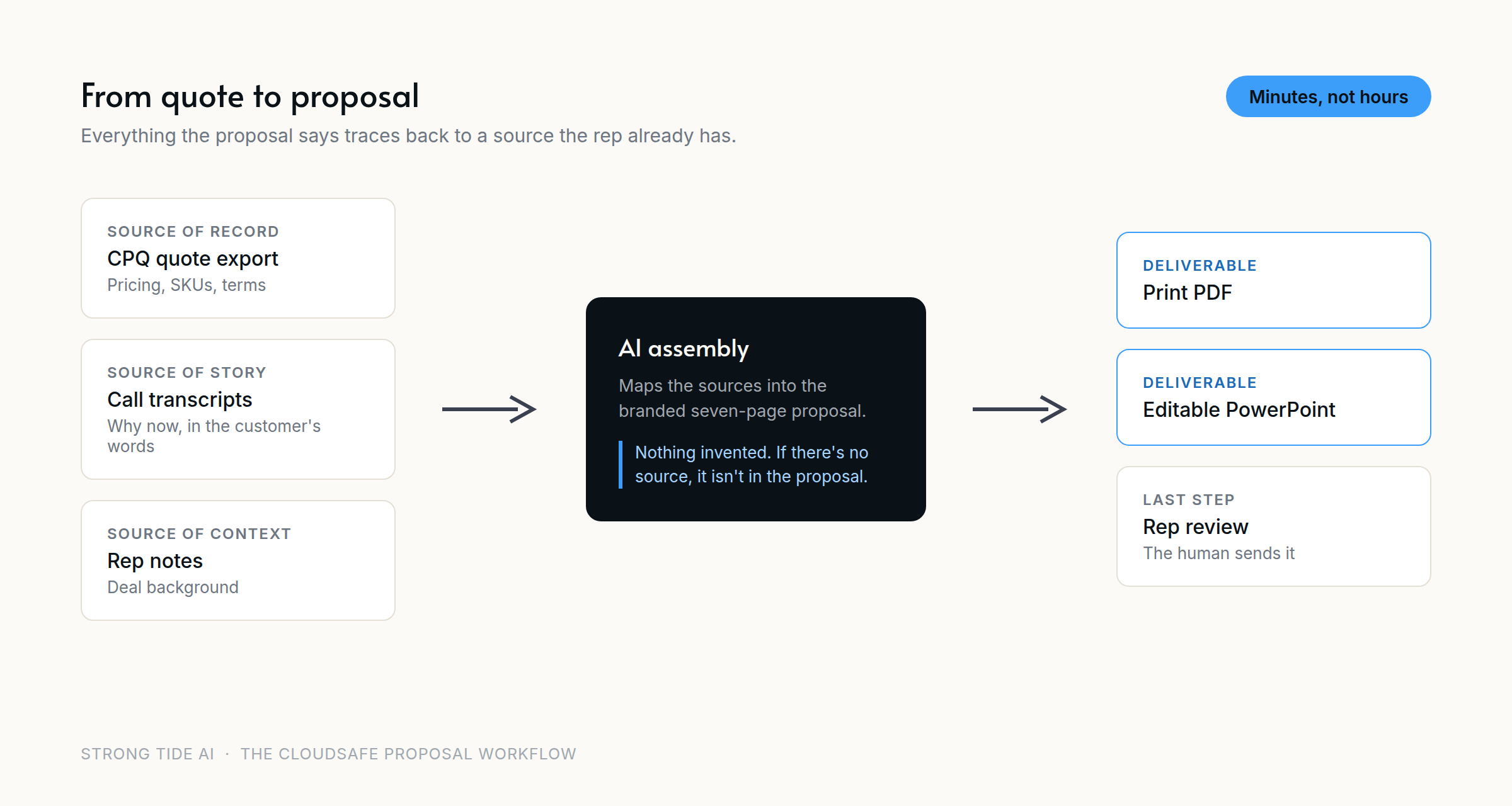
Pricing, SKUs, and terms come straight from the quote. The story (why now, what is driving the decision) comes from the actual call transcripts, often in the customer's own words. The rep reviews it, edits the deck if they want, and sends it.
An evening of assembly work became a review step.
The rule that makes it safe
Here is the part most AI sales tools get wrong. The system is not allowed to make things up.
Every number and SKU has to trace back to the quote. The narrative can only come from what the customer said on a call or what the rep wrote down. If there is no source for the customer's motivation, the proposal stays factual and says so. It never invents a discount or a managed service the customer didn't buy.
That constraint matters more than the speed. A proposal is a promise. If an AI writes one that claims something the customer isn't buying, you have a trust problem and maybe a contractual one. Fast and wrong is worse than slow.
Your version of this exists
The specifics are CloudSAFE's. CPQ quotes, hosting SKUs, Teams recordings. The pattern shows up in almost every B2B sales organization.
Somewhere in your sales process, deals wait on a document. Maybe it's a proposal or an SOW. Maybe it's the business case your champion needs for their CFO. The raw material already exists in your quoting system, your call recordings, and your reps' notes. A person spends hours reassembling information you already captured, and the deal ages while they do it.
That gap is where AI belongs. The rep keeps the relationship and the final review. AI does the assembly: read the sources, map them into your format, hand back something that is 95 percent done.
The math is simple. Faster proposals shorten deal cycles. A consistent process makes your best rep's quality the baseline for every rep. Hours given back to the team turn into more deals worked at once.
Where to start
Skip the flashy stuff. Ask one question instead: where do our deals wait on a document, and does the information in that document already exist somewhere?
Find that point. Build the workflow so it can only say what your systems and your customers actually said, and put a human review before anything ships. Customers won't notice the AI. They'll notice the answer came back faster and sharper than anyone else's.
That's what it looked like at CloudSAFE. Your version probably looks a lot like it.