A senior operator's read on what AI actually does for a middle-market business.
Most of the AI writing aimed at middle-market CEOs gets the easy parts right and skips the hard ones. The easy parts are the general-purpose ones. Machine learning is changing how work gets done. Large language models are a new tool in the toolkit. Governance matters, data matters, people matter. Most of that is true, and almost none of it helps you decide anything on a Tuesday morning when your exec team wants to know what you actually want to do about AI.
What would help is a conversation that takes your specific business seriously. Which means talking about where you are, what you sell, who you compete with, and what the next eighteen months look like in your actual P&L. For CEOs of middle-market companies on Long Island, that conversation has a handful of features you don't get in the generic version.
Long Island runs on a particular kind of company
If you drew a circle around Nassau and Suffolk and asked which middle-market businesses live inside it, the answer is not a random cross-section of the US economy. The Island runs on a few industries, and they shape how AI decisions should go for the companies inside them.
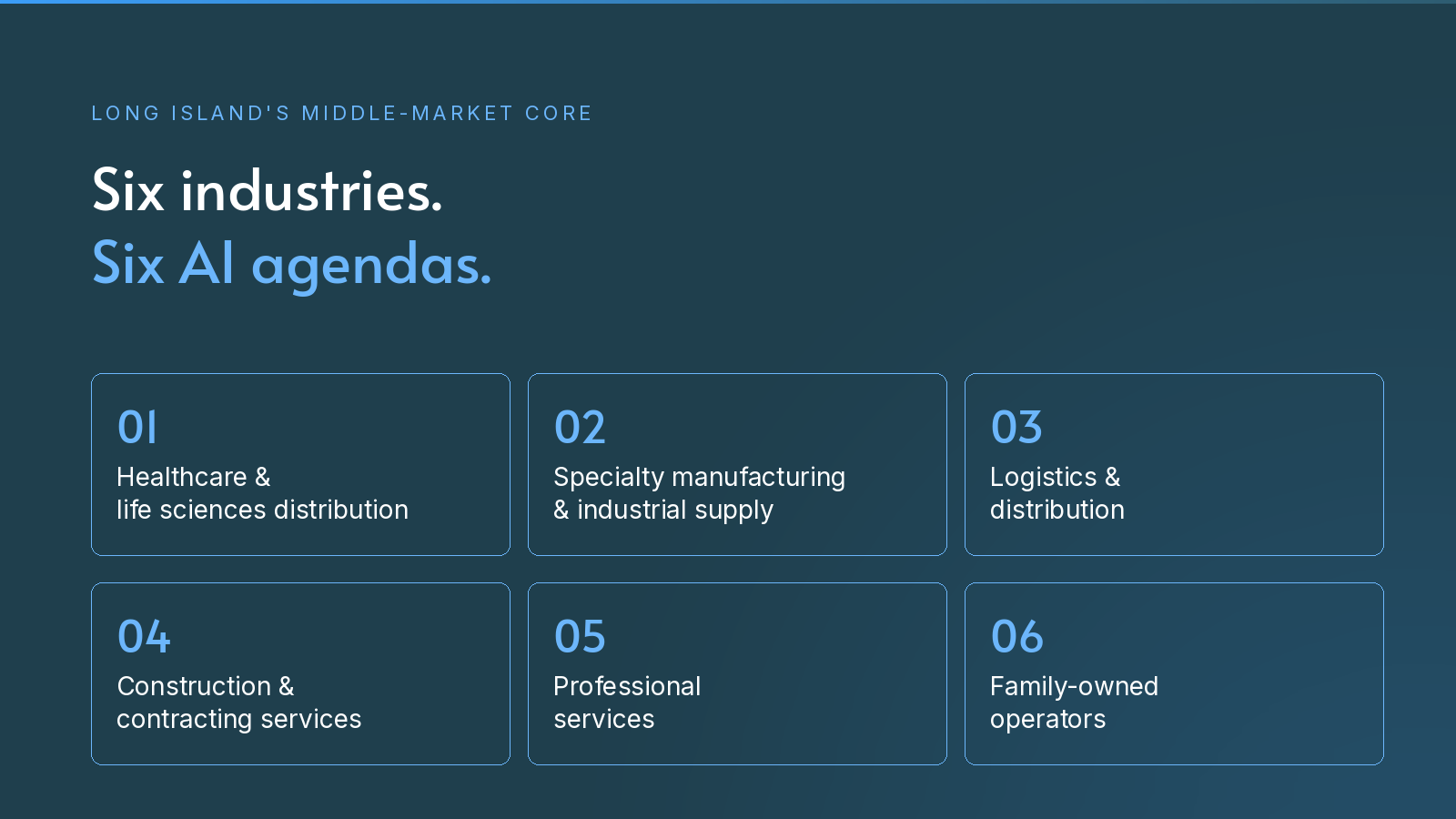
There are plenty of exceptions, but if you're running a $40M logistics firm in Hauppauge or a $120M industrial supply business in Farmingdale, you're closer to the center of gravity than you are to the edges.
These industries are not software companies. They run on field operations, physical inventory, scheduled labor, skilled trades, customer relationships built over decades, and margins that can be sensitive to a few hundred basis points. That is not a complaint. It's the shape of the work, and it changes which AI decisions matter.
The question "should we be using AI" is the wrong question for a company like that. It's already being used. Your accounting team is running Copilot or ChatGPT in a tab. Your ops team has probably evaluated three scheduling or routing tools that claim to be AI-driven. Your sales team uses a CRM that now auto-summarizes every call. The question is which of those motions are real, which are noise, and which couple of bets on this would actually move your business in the next twelve months.
The talent market shapes every answer
Long Island middle-market companies compete for talent with New York City and New Jersey. That's not news. What gets less airtime is how much that one fact changes the AI math.

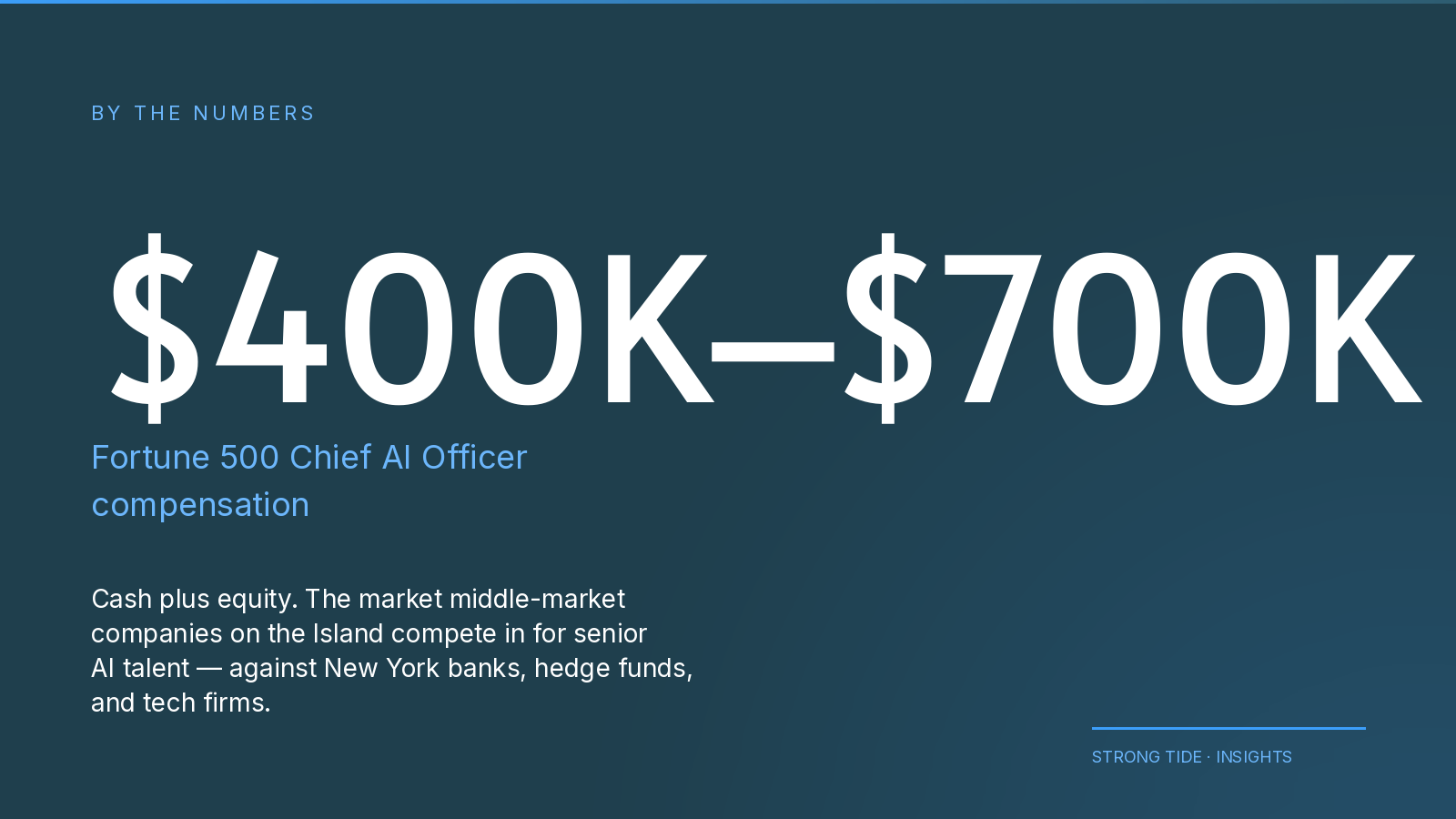
Consider what it would take to hire a full-time Chief AI Officer or Head of AI for a $60M company on the Island. The market for that role right now, at enterprise scale, is $400K to $700K in cash plus equity, and you compete directly with New York banks, hedge funds, and tech firms that will outbid you on every dimension. The people who can actually operate the role, as opposed to narrate it, are working at Anthropic or a hedge fund in Manhattan or a platform company in Boston. The pool of senior AI operators on the Island willing to work for middle-market comp is small, and the ones who are here have options.
The asset is pattern recognition from someone who has already led an enterprise through cloud, data, and digital. They see the bad calls before you make them.
Fractional and embedded operator models exist for this exact reason. They are the obvious answer for companies in your size range, and the economic case is not complicated: you pay for the judgment you actually need, when you need it, without absorbing the fully loaded cost of a role you may not need in steady state.
What "AI" actually looks like for a $40M logistics firm in Hauppauge
Abstract AI conversations get easier when you put numbers and addresses on them.
Take a $40M logistics firm based in Hauppauge. Family-owned, second generation, 120 employees, $3M EBITDA, margin under pressure from fuel costs and from two larger competitors who have spent the last three years investing in operations tech. What does AI look like in that business over the next twelve months?
It is not a generative AI chatbot on the website. It is not an enterprise data platform. It is probably: a disciplined evaluation of two or three scheduling and routing tools that your ops team has been looking at, with a real read on which one works and which one is a slick demo. It is probably a six-week project on document automation for proofs of delivery and BOLs that pays for itself in headcount redeployment. It is probably a clearer-eyed conversation with your insurance broker about which telematics and safety AI offerings actually reduce premiums versus which ones are repackaged. And it is probably a decision about whether to staff a small internal AI function, outsource it, or embed a fractional leader to run the above three motions in parallel for the rest of the year.
Now take a $100M specialty distributor in Melville. Same ownership shape, different business. What AI looks like there is different: a pricing optimization evaluation, a customer service automation that handles returns and order status without cannibalizing the relationship reps, a purchasing forecast that gets something better than the planner's gut, a careful read on which of the big distribution platforms are going to offer AI-native features that commoditize your moat in the next twenty-four months.
Different businesses, different answers. Both are AI decisions. Neither is the AI decision that gets written about in the Harvard Business Review.
Three things middle-market CEOs on Long Island should actually do

One. Get an honest internal read on where AI is already happening in your business.
Not a policy. A map. Which teams are using which tools, under what accounts, on what data, with what outcome. Most CEOs are surprised by how far this has already gone without a central decision. That map is the starting point for every other conversation.
Two. Pick one to three places where AI has a real chance of moving a number that matters.
Revenue, cost, retention, time to close, something your CFO would recognize. Ignore the rest for now. AI's surface area is infinite and the number of places it can actually pay for itself in your business is small. The discipline is saying no to ninety percent of what is possible so you can do two things well.
Three. Build a relationship with one or two people who have done this before at the scale above yours.
Not for slideware. For judgment calls. The AI decisions that hurt mid-market companies over the next two years will not be the ones they make in public with consultants. They will be the quiet ones. A bad vendor pick. A committee-driven roadmap that burns a year. A hire that was optimized for the wrong thing. An operator who has led companies through the cloud and data waves has calluses from those exact mistakes and will see them coming.
The shape of the conversation
I run a firm called Strong Tide. We work with middle-market companies, and we're based on Long Island. Most of the companies we talk to are somewhere on the spectrum between "we haven't done anything on AI yet" and "we did a few things and now we're not sure what to do next." Almost none of them need a technology vendor. They need a senior operator who can tell them which of the bets on the table are real, which are theater, and which would actually move their business if they were executed well.

The easiest way to find out if that's a useful conversation for you is a twenty-minute call. No slide deck, no pitch. We talk about where you are, where you're trying to go, and whether a two-week readiness sprint or an embedded fractional role is worth your time and budget. If it is, we spec it. If it isn't, I tell you, and you go on with your week.
More on this: The fourth wave looks a lot like the first three is the longer arc behind this work, drawn from the prior three technology waves and why the mid-market window is open right now.
More on our middle-market AI offering and on what working together looks like, specifically for Long Island companies, is on the Long Island page.