Most of the wasted money I see in mid-market AI does not get wasted on the tool. It gets wasted in the weeks before the tool, in the decision about where to point it. By the time a company has signed with a vendor, stood up a pilot, and pulled three people off their day jobs to run it, the expensive mistake has usually already been made. The budget was committed to the wrong workflow, against data nobody could reach, owned by a team that was never going to change how it works, approved by a leader who could not tell the difference. The software did its job. The aim was off.
So before you spend, it is worth running a short, honest check on whether you are actually ready to get a return. Not a strategy offsite, not a maturity model with forty rows. Four questions. I ask versions of these in the first hour of every engagement, and the answers predict the outcome better than any feature list a vendor will show you. Here they are, in the order that matters.
1. Is this a workflow worth the money, or just one that demos well?
The first failure is picking the wrong target. AI is good at a specific shape of work, reading, drafting, summarizing, finding patterns across a lot of text or numbers, and the temptation is to point it at whatever is easiest to show off rather than whatever is actually costing you. A chatbot on the website demos beautifully and changes nothing about your economics. The thing that would matter, the quote process that takes four days, the month-end close, the analyst bottleneck that delays every decision, is less photogenic and usually buried one level down.
The check is simple. Name the workflow. Then name the number it moves: hours saved, days off a cycle, revenue unblocked, a cost line that shrinks. If you cannot tie the AI project to a number a CFO already cares about, you do not have a project yet. You have an experiment, and experiments should be cheap and labeled as such, not sold to you as transformation.
2. Can the tool actually reach the information it needs?
The second failure is data, and it is the one vendors are quietest about. An AI tool is only as useful as what it can see. If the knowledge it needs to do the job is locked in someone's inbox, scattered across six systems that do not talk to each other, or written down nowhere because it lives in a senior person's head, no model fixes that for you. You will spend the first two months of a "build" doing data plumbing that nobody scoped.
The check: for the workflow you picked, ask where the information lives and whether a person could get to all of it in a few clicks today. If the answer is yes, you are in good shape. If the answer is "well, it depends" or "you would have to ask Janet," that is not a reason to stop. It is a reason to know that the data work is the project, and to price and sequence it honestly instead of discovering it after the contract is signed.
Most AI projects do not fail on the model. They fail on a workflow that did not matter, data nobody could reach, or a team that was never going to change. All three are knowable before you spend a dollar.
3. Who owns this after the consultant leaves?
The third failure shows up six months later. A tool gets built, it works in the demo, everyone claps, and then it quietly dies because no one inside the company actually owns it. The person it was built for goes back to their old way of working the first busy week, because the old way is a habit and the new way is still a decision they have to make every single time.
The check is about people, not technology. For the workflow you picked, who changes how they work on Monday? Name the actual person. Are they in the room now, or are they going to be handed a tool they never asked for? Adoption is not a training problem you solve at the end. It is a design constraint you build around from the start, and if there is no named owner who wants this, the most likely outcome is a working tool that no one uses.
4. Are you, the person approving this, fluent enough to judge it?
The last check is the uncomfortable one, and it is about you. Nearly every important call on an AI project is a judgment that depends on fluency: is this vendor demo real or theater, is nine months and a platform the right scope or empire-building, is this announcement a genuine threat or a press release. If the person holding the budget has never done the work themselves, that judgment gets outsourced to whoever sounds most confident in the room. I wrote a whole piece on this, because it is the quiet bottleneck on most programs I see.
You do not need to become an engineer. You do need enough hands-on reps that your gut is calibrated to what is easy and what is hard. An hour a week on your own real work does more for your ability to make these calls than any briefing ever will. If you are about to approve real money against AI and you cannot yet open the tool and use it on something from your own week, that is the first thing to fix, before the spend, not after it.
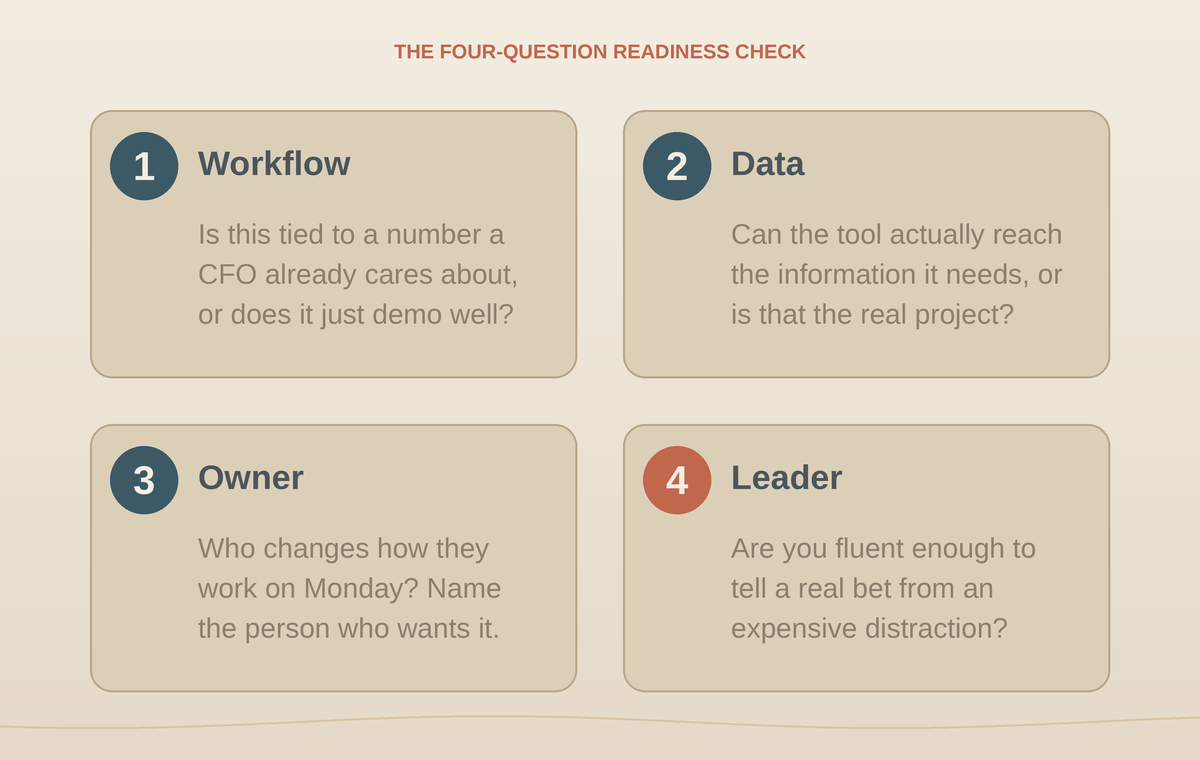
What to do with the four answers
Run the four questions on whatever AI project is in front of you right now. If you get a clean yes on all four, a workflow tied to a real number, data the tool can reach, a named owner who wants it, and a decision-maker who can judge the work, then go. You are more ready than most. If you get a no or a "sort of" on any of them, you have just found the cheapest problem you will ever solve on this project, because you found it before you spent.
This is, more or less, what our AI Opportunity Sprint does in a structured two weeks. It goes workflow by workflow, scores each one on exactly these dimensions, and hands you a ranked list of what is worth building, what needs foundation work first, and what to leave alone, with the numbers attached. You can run the check yourself on a whiteboard, and you should, before you talk to anyone. The point is not who runs it. The point is that the check happens before the money moves, not after.
More on this: Why middle-market AI strategies fail goes deeper on the workflow-selection trap, and Don't build an AI Center of Excellence covers the ownership question at the level of the whole org. When you want a second set of eyes on which projects are real, a twenty-minute call is the place to start.